


An Even Better Way to Zone
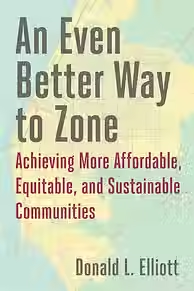
In our latest episode we interview zoning attorney and author Donald Elliott about his book An Even Better Way to Zone: Achieving More Affordable, Equitable, and Sustainable Communities. Elliott’s work comes alongside other recent zoning books covered on the show, including M. Nolan Gray's Arbitrary Lines (arguing for getting rid of zoning) and Sarah Bronin’s Key to the City, his approach aligning with reforming zoning rather than eliminating it. Elliott explains that his earlier book, A Better Way to Zone (released nearly 20 years earlier), focused on broadly applicable zoning “basics” and common misunderstandings, while the new book reflects two additional decades of practice and is more targeted.
Elliott says An Even Better Way to Zone concentrates on four substantive, current priorities that appear across many zoning projects: enabling more affordable housing, supporting more sustainable development, improving zoning outcomes for disadvantaged groups, and—most notably—zoning for continued reuse and redevelopment rather than focusing only on what communities want “today.” He frames zoning as a governance system, not a wish list, emphasizing that it defines legal rights to use property and therefore needs to anticipate ongoing change, especially in built-out places.
A major theme is that many communities apply “planning” thinking to zoning problems. Elliott distinguishes planning’s visioning approach—encouraging broad, aspirational ideas—from zoning’s role in regulating real sites with constraints. He argues codes often treat infill and redevelopment parcels as if they were raw land, even though infill sites are limited by existing utilities, terrain, neighbors, frontage, and other conditions. Because redevelopment is constrained, he says it requires more flexibility than edge-of-town greenfield development, and zoning should better educate the public about why infill cannot be regulated the same way as undeveloped land.
Elliott identifies common flaws in zoning codes, especially the heavy use of discretionary approvals based on vague standards. He argues that instead of doing the hard work of predefining what is allowed and consistent with the plan, many jurisdictions push projects into conditional use hearings or similar processes that become time-consuming “beauty contests.” Even compliant proposals must endure public hearings, increasing expense, uncertainty, and delay—factors that discourage innovation and can kill projects.
The conversation also addresses zoning’s exclusionary roots and how to use a tool “designed to exclude” to create more inclusive outcomes. Elliott’s core proposition is to exclude less and do so more thoughtfully, with a clear understanding of who benefits and who is harmed by exclusion. He argues that exclusion doesn’t eliminate market demand; it often displaces development into neighborhoods less able to resist—frequently poorer or less organized communities—reinforcing inequities. Often there are political challenges of reducing exclusion, including eliminating single-family-only zoning and expanding missing-middle options like duplexes and triplexes, and Elliott notes many cities keep 70–80% of land limited to single-family housing while trying to address affordability.
When asked what communities should remove immediately, Elliott mentions parking minimums as a common current target, noting many downtowns already function without them and the market can often handle parking supply. But he returns to his top priority: eliminating discretionary reviews based on vague design criteria such as “compatibility,” “harmonious,” or “high quality,” which invite subjective conflict and can perpetuate inequality. He references state-level actions limiting denials based on design standards or “neighborhood character.” He also urges administrative flexibility for redevelopment—such as allowing staff to approve small, justified deviations (e.g., 10–20%) to standards like setbacks or parking for constrained sites—arguing that the smaller the site, the harder it is to redevelop.
The episode closes with book recommendations Elliott lists: classic planning works including Jane Jacobs’ The Death and Life of Great American Cities and Kevin Lynch’s The Image of the City, as well as The Color of Law, M. Nolan Gray’s Arbitrary Lines, Sarah Bronin’s Key to the City, Richard Florida’s The New Urban Crisis, and Isabel Wilkerson’s Cast.


Comments